 English
 Español

What Features Should You Prioritize in a Power Reclining Sofa for Maximum Comfort? html
Posted by Admin | 23 Oct
Why “Power” Alone Does Not Guarantee Comfort
A power reclining sofa is often marketed as the automatic answer to living room relaxation. The logic seems simple: press a button, the footrest rises, the backrest lowers, and comfort follows. In practice, the gap between a well-engineered recliner and a budget model with a weak motor is enormous, and it shows up within the first year of daily use.
Electric drive is only the delivery mechanism. Maximum comfort depends on three deeper layers: the quality of the motor and mechanism, the ergonomic geometry of the headrest, lumbar zone, and seat, and whether the recliner physically fits your room. A sofa can have a flawless motor and still cause neck strain because the headrest is fixed. It can recline smoothly and still leave your heels hanging in mid-air. It can offer every tech feature on the market and still fail because it needs twelve inches of wall clearance your apartment does not have.
This guide separates the features that genuinely reduce fatigue from the ones that merely inflate the spec sheet. It is written for buyers who intend to keep the sofa for years, and for sourcing teams comparing factory options before requesting quotes.
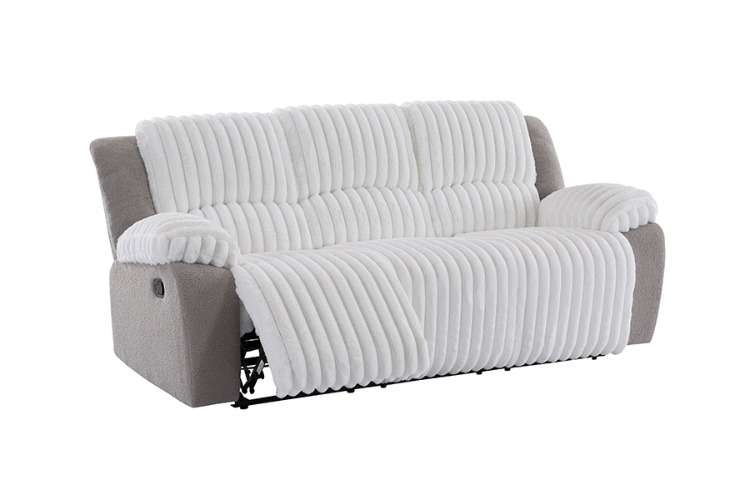
Core principle: Prioritize motor and mechanism quality first, ergonomic adjustability second, and space compatibility third. Tech extras come last, because no USB port compensates for a plastic gear that strips in eighteen months.
The Non-Negotiable Core: Motor and Mechanism Quality
The motor is the heart of any power recliner and the single largest hidden cost difference between price tiers. Two sofas can look identical in a showroom and differ by a factor of three in mechanism quality. Buyers rarely see this difference until a gear fails, a recliner stalls halfway, or a motor begins to whine during every movie night.
Steel Gears vs. Plastic Gears
Inside the actuator and the reclining mechanism, gears transfer load from the motor to the frame. Plastic gears are cheaper, quieter when new, and adequate for light use. Steel gears cost more and add weight, but they resist the repeated stress of a 200-pound user reclining twice a day for a decade. A practical benchmark: a quality recliner mechanism is rated for roughly 20,000 to 25,000 full recline cycles. Budget plastic gearing often falls well short of that figure under real-world loads.
| Component | Plastic Gear Set | Steel Gear Set |
|---|---|---|
| Expected cycle life | Lower, degrades under load | Higher, stable under load |
| Noise when new | Quiet | Slightly louder, then stable |
| Failure pattern | Stripped teeth, sudden stall | Gradual wear over years |
| Repair cost | Often mechanism replacement | Usually motor-only replacement |
| Best use case | Occasional seating | Daily family seating |
Smoothness and Noise Level
Motion quality is a sensory test, not a spec sheet number. A good recliner moves at a steady speed from fully closed to fully open with no jerk at the start and no thump at the end. Listen for motor whine, frame creak, and footrest rattle. In a quiet room, a quality mechanism should stay below normal conversation level, roughly under 50 decibels, so it does not interrupt dialogue on screen. Ask for a video demonstration with sound if you are buying remotely.
Manual Override and Battery Backup
This is one of the highest-value features in the entire category and one of the most frequently overlooked. A power recliner that cannot be reset during a power outage traps the user in a reclined position, which is a genuine safety concern for elderly users. Two solutions exist: a manual release that disengages the actuator, and a battery backup pack that powers several full cycles. Confirm which one is included, whether the battery pack is optional, and what battery type it uses.
When comparing quotes, ask for the recliner mechanism rating and the motor warranty in writing. A warranty of three to five years on the motor is a reasonable standard for mid-to-premium construction. Anything under one year signals a component intended to be replaced, not repaired.
Ergonomic Features That Actually Reduce Fatigue
Ergonomics is where the difference between a comfortable recliner and an exhausting one becomes obvious after thirty minutes. Advertising tends to blur the line between decorative padding and functional support. The three features below are worth paying for because each one addresses a specific fatigue pattern.
Power Headrest vs. Standard Headrest
A standard headrest is fixed to the backrest. As the backrest reclines, the headrest angle changes with it, which pushes the chin toward the chest during reading and forces the neck forward during television viewing. A power headrest adjusts independently, so the head stays upright while the body reclines. For anyone who reads, uses a tablet, or watches long films, this is the single most impactful upgrade in the category. It is also one of the clearest signals of a serious power reclining sofa build, because independent headrest actuators add cost and mechanism complexity.
Lumbar Support That Is Not Just a Pillow
A loose cushion placed behind the lower back shifts position the moment the user moves and provides inconsistent support. Functional lumbar support is built into the backrest structure, usually as an adjustable pad or an inflatable chamber that follows the natural inward curve of the lower spine. The test is simple: sit down, recline fully, and slide a hand behind your lower back. If you can fit a flat palm with light contact and no gap, the curve is working. If your hand disappears into empty space, the lumbar zone is too flat regardless of how much foam surrounds it.
Seat Depth and Fully Reclined Length
Seat depth determines whether the edge of the seat presses into the back of your knees, and fully reclined length determines whether your heels are supported. Both are measurable before purchase, and both cause returns when ignored.
| Measurement | Typical Range | Fit Check |
|---|---|---|
| Seat depth | 20 to 23 inches | Two to three fingers between knee back and seat edge |
| Fully reclined length | 62 to 72 inches | Heels rest on footrest with no overhang |
| Seat height | 18 to 20 inches | Feet flat on floor when seated upright |
| Armrest height | 24 to 26 inches | Shoulders relaxed, elbows at 90 degrees |
Shorter users often need a shallower seat and a lower fully reclined length; taller users need the opposite. A recliner that fits a 5-foot-4 user will leave a 6-foot-2 user with unsupported calves. Ask for both numbers before ordering, not after delivery.
Space-Saving Technology: Wall-Hugger vs. Standard Recliner
Insufficient wall clearance is one of the most common reasons power recliners are returned or left unused in a corner. A standard recliner needs roughly 10 to 12 inches of clearance behind the backrest to recline fully. A wall-hugger, also called a zero-wall recliner, uses a linkage that slides the seat forward as the backrest drops, reducing required clearance to about 3 to 4 inches.
The practical decision rule: measure the distance from your wall to the front edge of the intended sofa position. If that distance is under 12 inches, a wall-hugger is not a luxury, it is a requirement. For apartment living rooms, open-plan layouts with furniture against a walkway, and narrow media rooms, a wall hugger power reclining sofa resolves the problem before it begins. Confirm the exact figure in the specification, because “zero wall” is used loosely and some designs still need six inches.
The Tech Features Worth Paying For, and What to Skip
Tech features are the easiest place to overspend. They are visible, easy to demonstrate, and often used to justify a higher price while the mechanism underneath stays mediocre. Use the following ranking as a filter.
USB and USB-C Ports
Genuinely useful, especially when the port sits within arm’s reach and delivers modern charging power. Two cautions apply. First, confirm the port output; a 5-watt port will not meaningfully charge a tablet. Second, ask about standby power draw, because a permanently lit port and control panel can add a small but continuous load. A switched power supply or low standby rating solves this.
Programmable Memory Positions
Underrated and quietly excellent for multi-user households and older users. One button returns the sofa to a saved reading position or a saved full-recline position, which removes the trial-and-error of holding a button until it feels right. For anyone with limited mobility or arthritis, memory presets are a meaningful accessibility feature, not a gimmick.
Heat and Massage
Honest assessment: these are preference features. Heat can be pleasant in a cold room, and massage can be soothing, but neither compensates for poor lumbar geometry or a weak motor. If a choice must be made, keep the steel mechanism and the power headrest and drop the massage module. Also confirm that heat and massage have independent controls and automatic shutoff.
| Feature | Priority | Reason |
|---|---|---|
| Steel mechanism | Essential | Durability under daily load |
| Power headrest | High | Neck comfort during reading and viewing |
| Wall-hugger linkage | High if space is tight | Prevents the most common return cause |
| Battery backup | High | Safety and usability during outages |
| Memory presets | Medium | Convenience and accessibility |
| USB-C ports | Medium | Practical charging, check output |
| Heat and massage | Optional | Personal preference, not structural comfort |
How Much Does a Quality Power Reclining Sofa Cost?
Price differences in this category are driven mainly by three variables: motor and mechanism grade, the number of independent actuators, and upholstery and frame construction. A single-motor sofa with a standard headrest and a plastic gear set sits at the entry tier. A dual-motor sofa with a power headrest, steel mechanism, wall-hugger linkage, and battery backup sits in the mid-to-premium tier. Each added actuator and each upgrade in gear material moves the factory cost meaningfully.
The most reliable way to compare offers is to send your required specification, including seat count, recline layout, headrest type, wall clearance, upholstery, and warranty expectations, and request a factory-direct quote against that exact list. A written quote against a defined spec is far more useful than a catalog price, because it exposes which features are driving the number and where a substitution can save cost without hurting comfort.
How to Test a Power Reclining Sofa Before You Buy
Whether you are in a showroom or evaluating a sample remotely, use the same checklist. It takes about ten minutes and catches most of the failures that appear later.
- Listen to the motor through a full cycle. Note whine, creak, and any thump at the end of travel.
- Run the cycle five times in a row and check for speed variation or hesitation.
- Recline fully and check heel support and lower-back contact.
- Adjust the headrest independently and confirm it holds position under head weight.
- Run a hand along seams and check stitch density and fabric alignment at stress points.
- Ask for the motor warranty, the mechanism cycle rating, and the wall clearance figure in writing.
- Confirm the manual override or battery backup procedure and test it if possible.
- Check standby power behavior: does the control panel stay lit when idle?
For remote sourcing, request a video that shows a full recline cycle with sound, a close-up of the mechanism under the frame, and a measurement of wall clearance in the actual sample. A supplier confident in the build will provide this without hesitation.
Conclusion: Build the Priority Order Before You Compare Prices
The features that maximize comfort are not the longest list, they are the right sequence. Start with a steel mechanism and a motor with a written multi-year warranty. Add an independently adjustable power headrest and functional lumbar support. Confirm that the seat depth and fully reclined length match the user’s body, and that the wall clearance matches the room. Then, and only then, consider USB ports, memory presets, heat, and massage.
Next step: Send us your room dimensions, preferred seat count, and the features you have prioritized. We will confirm fit, flag any clearance conflict, and return a factory-direct quote against your exact specification within 24 hours.
Frequently Asked Questions
Q1: Is a power reclining sofa worth it compared with a manual recliner?
For daily use by multiple people, yes. Power operation removes the physical effort of pushing back, and features like memory presets and power headrests are only possible with electric actuation. The trade-off is dependence on power, which is why battery backup or a manual override matters.
Q2: How much wall clearance does a power recliner need?
A standard recliner typically needs 10 to 12 inches behind the backrest. A wall-hugger or zero-wall design reduces this to about 3 to 4 inches by sliding the seat forward as it reclines. Always confirm the exact figure for the specific model.
Q3: How long should a recliner motor last?
A quality mechanism is commonly rated for 20,000 to 25,000 full recline cycles. At two cycles per day, that is well over a decade of use. Plastic gear sets typically fall short of this under real loads, which is why gear material matters more than motor brand claims.
Q4: What is the advantage of a power headrest?
It adjusts independently of the backrest, so the head stays upright while the body reclines. This reduces neck strain during reading, tablet use, and long viewing sessions. It is the ergonomic upgrade with the clearest day-to-day benefit.
Q5: Can heat and massage replace proper lumbar support?
No. Heat and massage are comfort preferences. Lumbar support is structural: it maintains the natural curve of the lower spine. If the backrest geometry is flat, no massage module will correct it.
Q6: How do I compare quotes from different suppliers?
Define your specification first, including mechanism grade, number of actuators, headrest type, wall clearance, upholstery, and warranty terms. Then request quotes against that identical list. Comparing catalog prices without a fixed spec usually hides the differences that matter most.

 Floor 2 No.533 Shuangqiao Road, Dipu Street, Anji County, Huzhou City, Zhejiang Province, China.
 Josie@boshenfurniture.com
 0086-15105823033
Copyright © BOSHEN FURNITURE CO., LTD. All rights reserved.OEM/ODM Upholstered Seating Furniture Manufacturers
