 English
 Español

Best Sectional Sofa for Small Living Room: 2026 Sizing, Fabric & Layout Guide
Posted by Admin | 24 Sep
Choosing a sectional sofa for a small living room is not the same exercise as picking one for a spacious open-plan area. In a compact room, every centimeter affects traffic flow, natural light, and the feeling of openness. A sectional that is too deep can block a doorway; a chaise on the wrong side can force you to walk around it every time you enter.
We design and manufacture upholstered seating for small homes, including compact sofas, manual and power reclining sectionals, and loveseats. This guide is based on the same engineering checks we apply to our own production line: access-path dimensions, seat depth, mechanism clearance, and material behavior in daily use. By the end, you will know exactly what to measure in your apartment and which sectional configuration works best for the way you actually live.
Why a Sectional Sofa Works in a Small Living Room
A sectional is often recommended for compact rooms because it consolidates seating into one defined footprint. A conventional setup with a three-seat sofa, two accent chairs, and a side table spreads furniture across several walls. The same seating capacity can sit along two adjacent walls in an L-shape, using the corner that would otherwise remain empty. From a floor-plan perspective, an L-shaped sectional typically leaves 15 to 20 percent more clear floor area than a sofa-plus-chairs arrangement with the same number of seats, because the corner is no longer dead space.
There is also a visual benefit. Fewer individual pieces mean fewer legs, fewer gaps, and a smoother sight line across the room. In a small apartment, this continuity makes the space feel larger. For many of our customers, a 200 to 230 cm sectional with a 60 to 80 cm chaise provides the lounging comfort of a large sofa while leaving room for a dining table or a home office corner. The key is to distinguish between a sectional that simply has a recliner at one end and a true space-planning sectional with a dedicated chaise. The latter is designed around lounging, so the seat depth and the slope of the backrest are optimized for long sitting sessions.
How to Measure Your Room and Access Paths Before Buying
Before comparing models, measure the room and every path the sofa must travel. A sectional that looks perfect in a showroom can fail in a real apartment because of a narrow stairwell or a tight 90-degree turn. The reliable sequence is: measure the room, draw the walls with windows and doors, mark the entry route, and only then shortlist models.
Minimum measurements to record
- Room length and width at the widest and narrowest points. Most urban living rooms are 3 to 3.6 m wide; a sectional of 220 to 260 cm along the long wall is a comfortable range.
- Doorway width and height on the route from the entrance to the room. Apartment doors usually measure 80 to 90 cm. A sectional split into pieces avoids this limit; a fixed one-piece unit does not.
- Staircase, elevator, and corridor clearance. Vertical drops and 90-degree bends are the most common reasons a sectional cannot be delivered or must be returned.
- Distance from the wall to the nearest power outlet. This matters if you choose a power reclining sectional with a charging port.
- Window sill height and radiator depth. A backrest placed against a low window can block light and ventilation.
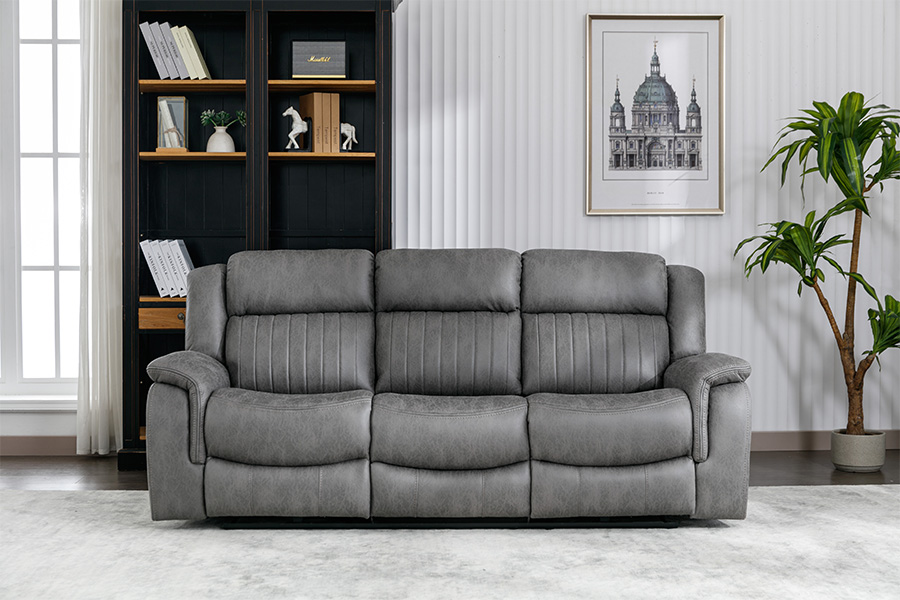
For very compact floor plans, a 200 to 210 cm sofa with a manual reclining function serves as the practical alternative to a full sectional. It gives you an extended footrest when you need it and acts as a normal sofa the rest of the time.
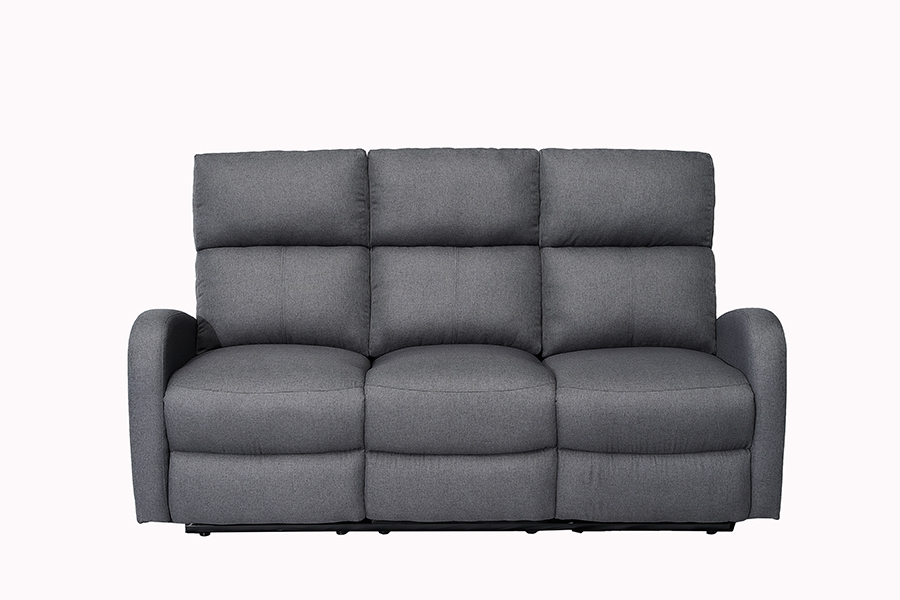 Compact Manual Reclining Sofa for Small Living Rooms and ApartmentsThis compact reclining sofa serves as a practical alternative to a full sectional, offering an extended footrest when needed. Its simple pull-tab mechanism and neutral polyester fabric suit smaller spaces while maintaining everyday comfort.View Product →
Reference dimensions for common small living rooms
| Room type | Available wall | Max sectional length | Recommended depth | Best configuration |
|---|---|---|---|---|
| Studio under 20 m2 | 180-220 cm | 200 cm | 85-90 cm | Two-seat with chaise |
| One-bedroom apartment | 220-300 cm | 240-260 cm | 90-95 cm | L-shape, reversible |
| Small family living room | 300-360 cm | 280-300 cm | 95-100 cm | L-shape or modular |
These values are starting points, not fixed rules. A long, narrow room allows a deeper seat because the walking path runs at the front; a square room requires a shallower seat on at least one side. If the room is rectangular, orient the sectional along the longer wall; if it is square, orient it along the wall that faces the primary seating position.
L-Shape, Reversible Chaise, or Modular: Which Configuration Fits Small Rooms
Three configurations dominate the small-room market: the classic L-shape, the reversible chaise, and the modular sectional. Each one changes how the sofa interacts with the floor plan.
- L-shape: the chaise is fixed on one side. It is ideal when a window, a door, or the television position clearly determines where the long seat should sit.
- Reversible chaise: the chaise can be moved to the left or right during assembly. This works well for renters who may rearrange the room or move apartments.
- Modular sectional: built from independent units, so you can add an ottoman, remove the chaise, or turn the base into a guest-sleeping layout. Modular units also pass through narrow doorways more easily because they are transported separately.
From a manufacturing point of view, the internal structure matters more than the shape name. Look for a sectional whose seat and chaise units connect with metal brackets or interlocking fixtures, not bolts pulled through the upholstery. The corner unit carries the highest load, so ask whether it has a reinforced frame and whether the seat cushions can be flipped and swapped between units.
In a small room, a chaise with storage or a hidden compartment adds practical value by holding blankets and cables while keeping the visual surface clean. For rooms between 16 and 24 m2, a manual reclining sectional with chaise armrests and cushions is a balanced choice: it offers one full lounging position without the wall-clearance requirements of a power mechanism.
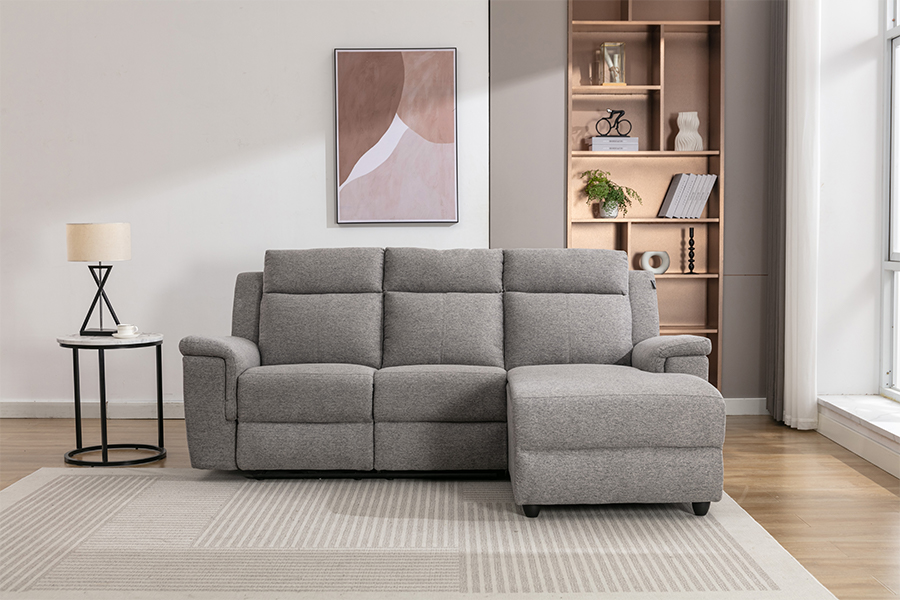 Manual Reclining Sectional with Chaise Armrests and CushionsDesigned for mid-sized rooms, this sectional combines a pull-tab recline on the left-arm side with a chaise on the right. Its attached cushions and high-resilience foam provide comfort, while the layout flexibility supports changing apartment needs.View Product →
As we explain in our guide to sectional sofas that bring flexibility to modern living spaces, the ability to change the layout without buying a new sofa is a real advantage in apartments that serve multiple functions. A reversible or modular base lets you respond to changes in your home.
Fabric, Foam, and Frame: What Determines Long-Term Durability
Fabric, foam, and frame decide whether a sectional can survive five years in a small living room. Because a compact room pushes a sofa into multiple functions such as sitting, resting, working, and dining, the upholstery receives more wear per square meter than in a large home.
Fabric comparison for daily living
| Fabric type | Wear resistance | Cleaning effort | Feel | Best suited for |
|---|---|---|---|---|
| Polyester tech fabric | Very high | Wipe with cloth | Smooth and cool | Pets and daily use |
| Thick polyester fabric | Very high | Vacuum and wipe | Sturdy and dense | Long sitting hours |
| Faux leather | Medium | Wipe only | Smooth | Style without pets |
| Faux fur with sherpa | Medium | Regular vacuuming | Soft and warm | Low-traffic corners |
For a small room, polyester tech fabric is the pragmatic first choice. It resists liquid stains from coffee and wine, prevents dust from embedding into the yarn, and keeps a more consistent temperature than synthetic leather. If you want the warmth of a natural fiber without the maintenance, a sherpa or faux fur is acceptable on a single accent cushion, not on the whole sofa.
Frame and suspension checks
A kiln-dried hardwood frame with corner reinforcement resists twisting when you sit on the chaise corner, which is the point that receives the most force. Budget frames using plywood or particleboard are lighter and cheaper, but they can develop creaks after two or three years of daily use. The suspension matters as much as the frame. Sinuous steel springs with a protective foam pad give consistent support and do not need frequent readjustment. In our factory, we test frames with repeated load cycles before shipment because a sagging seat makes a compact room feel worn out even when the fabric still looks new.
A removable, washable cover is an underrated feature for small homes, especially when the sofa is used for eating or working. It extends the service life of the fabric and keeps the sofa presentable without professional cleaning.
Manual vs Power Reclining: Which Mechanism Fits a Small Room
Reclining adds comfort but introduces an engineering constraint: space behind the backrest. In a small living room, the worst outcome is a recliner that needs 40 cm of wall clearance and blocks a doorway when fully open. Always check the manufacturer's stated clearance before finalizing the model.
Manual reclining sectionals, operated by a push-back or pull-tab action, are simpler, lighter, and less expensive to service. They are a good match for households that use the reclined position occasionally. Power reclining sectionals add a motor, transformer, and controls; they allow smooth adjustment at any angle and often include charging ports, which is practical because small living rooms rarely have enough outlets near the sofa. The trade-offs are weight, price, and the need for an electrical outlet.
Key questions to ask about any reclining mechanism
- How many centimeters of wall clearance are required for the full recline position?
- Can the mechanism be locked in an upright position when guests are over?
- Are the mechanisms tested for repeated cycles in the factory?
- Can the motor be replaced without disassembling the entire sofa?
- Does the frame stay stable when the footrest is extended on a thick rug?
For apartments where outlets are far from the seating area, a power reclining sectional with an invisible charger socket solves the charging problem without exposed cables. It allows you to place the sofa where the room wants it, not where the outlet forces it.
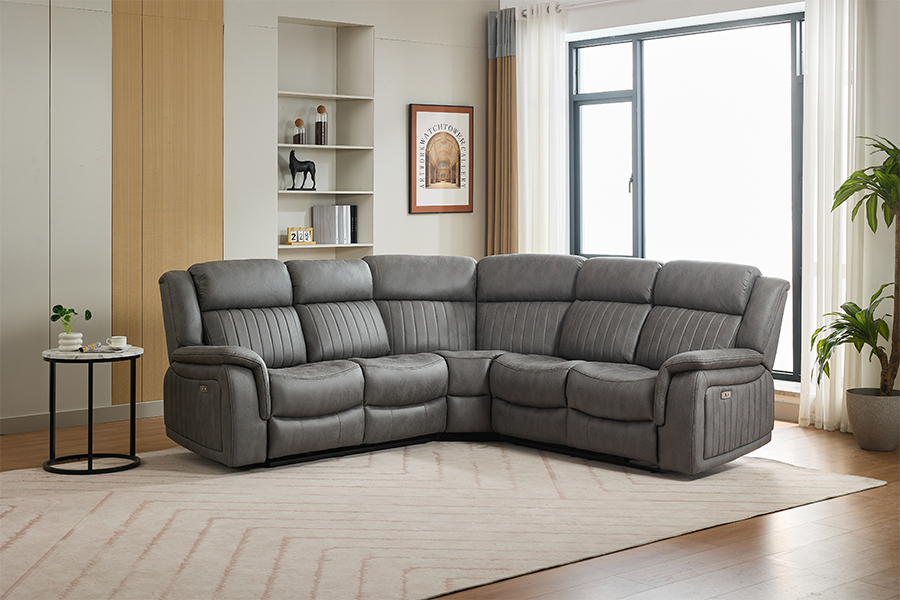 Power Reclining Sectional with Invisible Charger Socket and Cup HoldersThis power sectional includes an invisible charger socket and dual cup holders, letting you place seating away from wall outlets. The pull-tab recline and technical fabric upholstery make it a practical choice for flexible living room arrangements.View Product →
Layout and Styling Tips to Keep a Small Room Visually Open
Do not push every piece of furniture against the wall. In a small living room, sliding the sectional 10 to 15 cm away from the wall creates depth and lets air circulate behind the backrest, which also reduces dust buildup. If the room has a radiator, keep at least 10 cm between the sofa and the radiator to prevent fabric discoloration.
The chaise side defines the traffic route. Ideally, the path from the entrance to the main window or balcony should not cross the television zone. If the entrance is on the left, place the chaise on the right, or choose a reversible configuration.
Do
- Choose low arms and visible legs to keep the visual line light.
- Match the sectional color to the wall color for a seamless and expansive look.
- Use one floor lamp instead of several table lamps to reduce visual clutter.
Avoid
- Oversized pillows and thick throws that visually compress the seating area.
- Two full-size chaises on a corner sofa; one chaise is normally enough for a compact room.
- Dark, high-contrast upholstery in a room with limited daylight.
A rug that extends 20 to 30 cm beyond the sectional on all open sides anchors the seating zone. Keep the front legs of the sectional on the rug for a cohesive arrangement, or keep all four legs off the rug if you want easier cleaning.
Frequently Asked Questions
Q1: Are sectional sofas actually good for small rooms?
Yes, when the layout is planned. A sectional combines several seats and uses the corner, which frees the center of the room. The main risk is depth; choose a model with an overall depth under 100 cm and a chaise no longer than 150 cm if the space is tight.
Q2: What is the ideal depth for a sectional in a small living room?
A seat depth of 90 to 100 cm suits lounging, while 80 to 90 cm supports an upright sitting position for working or eating. An overall depth above 110 cm is usually too much for a room under 3 m wide.
Q3: Can a reclining sectional work when placed against a wall?
Yes, if the mechanism is designed as a close-to-wall system or if you leave the clearance written in the specification. Manual mechanisms generally need more space behind the backrest, while some power mechanisms operate with a gap of 5 cm or less. Test the full recline position before fixing the layout.
Q4: Which fabric holds up best in daily small-room use?
High-density polyester technical fabric offers the best combination of wear resistance, stain release, and cleaning ease for most homes. Faux leather is easier to wipe but less breathable in summer, and sherpa fabrics work best in low-traffic corners such as a bedroom reading chair.
Q5: How do I get a deep sectional through a narrow apartment door?
Choose a sectional that splits into separate seat and chaise units, with each unit measuring less than 80 cm at its narrowest point. Modular designs are easier to move and can be assembled inside the room, which also helps during a future move.
Final Advice from a Manufacturer's Perspective
The best sectional for a small living room is the one that fits the room in two senses: physical dimensions and daily function. Start with measurements, choose a configuration that leaves a clear path, verify fabric and frame quality, and check mechanism clearance if you want full reclining comfort. A sectional that passes those checks will feel spacious even in a compact apartment.
If your floor plan is unusual, discuss it with a manufacturer before ordering. An experienced upholstered furniture producer can adjust the width, chaise direction, or recline mechanism to suit the room, which is often more practical than forcing a retail model into a space that does not fit it. You can reach us through our contact page and attach your room drawing together with your requirements.
Related Products

 Floor 2 No.533 Shuangqiao Road, Dipu Street, Anji County, Huzhou City, Zhejiang Province, China.
 Josie@boshenfurniture.com
 0086-15105823033
Copyright © BOSHEN FURNITURE CO., LTD. All rights reserved.OEM/ODM Upholstered Seating Furniture Manufacturers
