 English
 Español
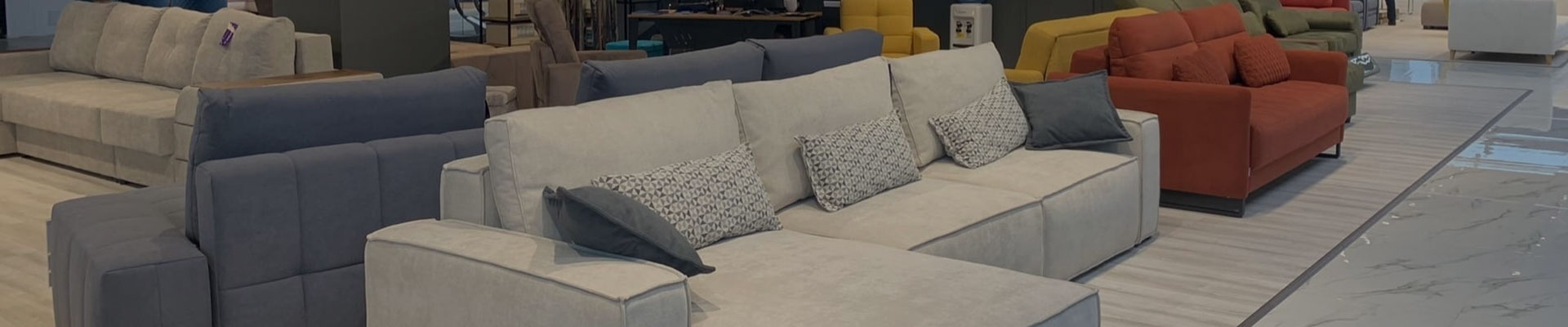
Modular Sofa for Flexible Living Space: Design, Layout, and Buying Guide
Posted by Admin | 17 Sep
Furniture decisions are rarely permanent. A layout that works today may feel cramped or underused after a move, a new roommate, or a shift toward working from home. This is why a modular sofa for flexible living space has become a central solution in modern interior planning. It can be rearranged, extended, reduced, and adapted without replacing the entire piece. This guide explains what modular sofas offer, how to plan a configuration around your room, and which materials and mechanisms deliver long-term value.
What Defines a Modular Sofa System
A modular sofa replaces a single welded frame with individual seating units that attach and detach through metal or plastic connectors. The result is a piece that can run as a straight bench today, become an L-shaped sectional tomorrow, and split into two separate seats after a move.
The main components are usually:
- Armless seat: a self-contained seating block with or without a backrest
- Corner unit: turns the run by 90 degrees
- Chaise with armrest: provides a continuous lounging surface
- Ottoman: loose footrest and temporary side table
- Back and arm panels: snap onto the seat blocks for additional support
Two construction details separate a useful modular system from a gimmick. First, connectors must keep modules rigid during daily use but release cleanly when needed. Second, every module should be able to attach on at least two sides; otherwise the system can only form one or two layouts. A well-designed manufacturer also keeps module footprint aligned so that rearrangement never produces uneven seat heights.
Modularity also changes how you maintain the sofa. A fixed three-seater usually fails at one point: a worn cushion, a broken spring, or a damaged cover. In a modular system, the affected seat can be removed, repaired, or reupholstered without retiring the whole sofa. For households with children and pets, this service advantage often matters more than the ability to change layouts.
Why Flexible Living Spaces Need a Modular Plan
Rental turnover is one strong reason. According to a 2025 survey by a global interior research group, 58 percent of apartment residents rearrange their living room within the first year, while only 27 percent own furniture that can change shape. Rooms that host a dining table, a desk, and a sofa push people to rebalance the floor plan several times a year.
The percentage of homes using the living room for three or more activities has also risen. Interior design trade reports put that figure above 40 percent for apartments completed after 2020, and the number continues to climb as remote work becomes permanent. A sofa that only faces the television cannot serve a room that also contains a desk and a folding dining table.
A modular sofa matches those changes by allowing three types of adaptation:
- Spatial adaptation: reduce or increase the number of seats as roommates come and go
- Functional adaptation: switch from a formal seating line to a lounging corner for movie nights
- Move adaptation: carry modules separately through narrow doors and stairs, then reassemble them in the new room
The same logic applies to open-plan apartments where the sofa acts as a room divider. An L-shape can mark the boundary between the living area and the kitchen while keeping sight lines open. The same unit can then be flattened against the wall when guests arrive. As manufacturers explain in this guide to sectional sofas for modern living spaces, the ability to switch between open and closed layouts is exactly what flexible rooms require.
Market insight: Trade associations that track seating purchases report that modular and sectional sofas now account for more than one-third of living room seating sales in North America and Western Europe, up from roughly one-fifth in 2015.
Core Module Types and Configuration Options
A modular system earns its name only if it offers a meaningful range of configurations. The table below summarizes the most common modules and how they behave in real rooms.
| Module | Primary Role | Typical Use |
|---|---|---|
| Armless seat | Core seating block | Straight runs, middle of an L |
| Corner unit | Changes direction by 90 degrees | Turning around a window or wall |
| Chaise with armrest | Extended legroom | Lounging zones near a balcony or TV |
| Ottoman | Movable footrest or table | Temporary surfaces |
| Power recliner seat | Motorized recline and charging | Media rooms and reading corners |
Matching modules to room geometry
Three configurations cover most apartments. The straight line needs only armless seats and works well against a wall. The L-shape adds a corner unit or a chaise that extends toward the window. The U-shape uses left and right chaises with seats in the middle, ideal for conversation in large open rooms.
When space allows, a sectional with a chaise and reclining seats gives you the comfort of a lounge chair without losing the modular principle.
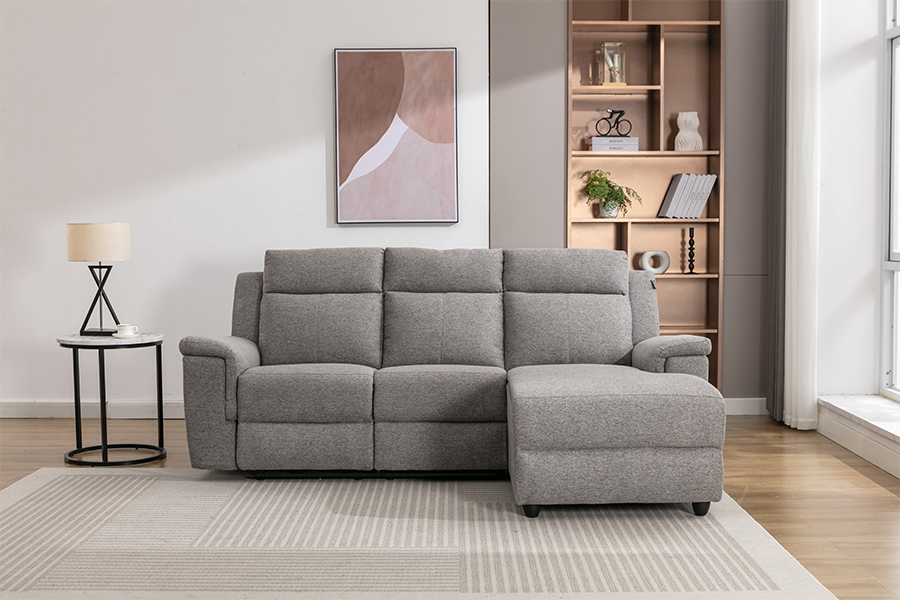 RC-7088 Polyester Manual Reclining Sectional Sofa with ChaiseThis manual reclining sectional combines a pull-tab mechanism on the left arm with a right-arm chaise for flexible seating. Its high-resilience foam and easy-clean upholstery make it a practical choice for open living areas.View Product →
Space Planning Strategies That Make a Modular Sofa Work
Measure the room before choosing a configuration, not after. Start with the wall length: this defines how many armless or corner modules fit without blocking windows or radiators. Next, measure circulation depth. A walking path of at least 60 centimeters should remain clear when all modules are in their largest arrangement. In front of a coffee table, add another 40 centimeters for legroom.
Three layout principles make the best use of a modular system:
- Place the back of the sofa toward the entrance in open plans to create a visual divider.
- Keep reclining modules near a window only if the fabric resists fading.
- Test the narrowest doorway and stair landing with the largest module in mind.
Also consider the depth of the chaise module. In a room that is only 3.5 meters wide, a deep chaise can consume almost a third of the walking space. Measure from the back of the module to the front edge of the seat and compare it with the width of your main path.
The diagram below compares the three most common seating arrangements.
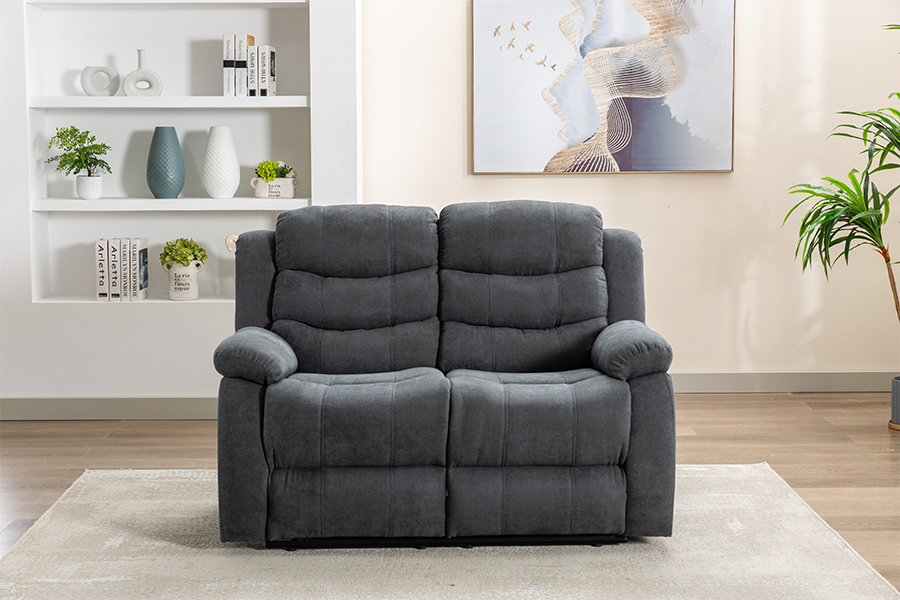
Once you know the room constraints, choose a smaller starting set and grow from there. In compact apartments, a two-seat manual reclining sofa is often the best starting point; it passes through standard door frames and leaves space for a dining table.
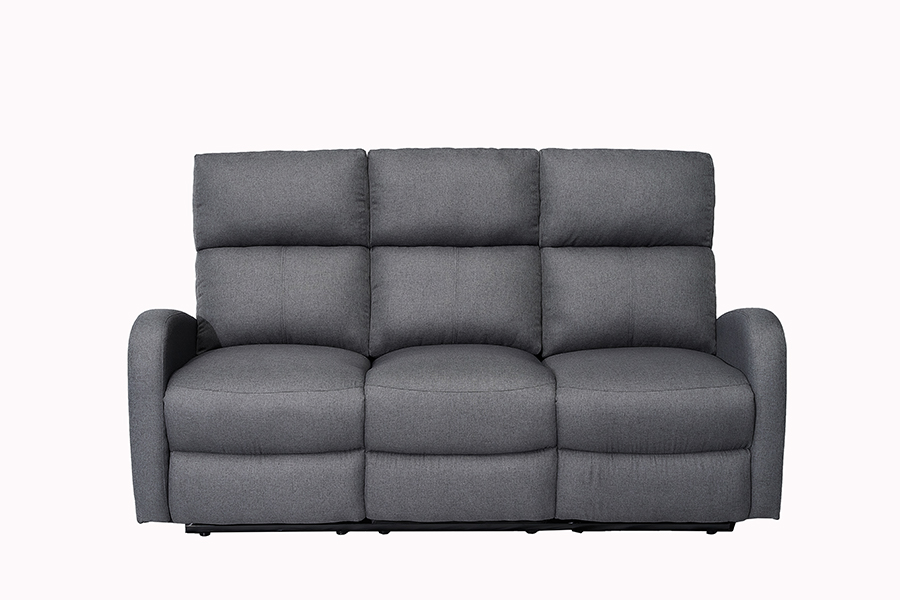 RC-2325 Compact Manual Reclining Sofa for Small ApartmentsA space-saving reclining sofa with ultra-soft polyester upholstery and a simple pull-tab recline. Its neutral palette and durable frame are well suited as a starting piece in tighter rooms before expanding the layout.View Product →
Only add an ottoman or a corner unit after you verify daily traffic patterns. That way every additional module earns its floor space instead of competing with it.
Fabrics, Cushion Fill, and Frame Construction That Last
Modularity multiplies the number of seams, joints, and moving parts. That makes material selection more important than on a fixed sofa.
Fabric options compared
| Fabric | Durability | Maintenance | Best For |
|---|---|---|---|
| Thick polyester | High | Vacuum and spot clean | Busy households and pets |
| Polyester tech fabric | High | Resists stains | Daily living rooms |
| Faux leather | Medium | Wipe with damp cloth | Minimalist spaces |
| Faux air leather | Medium to high | Breathable, easy to clean | Power recliners, warm climates |
| Faux fur with sherpa | Low to medium | Needs vacuuming | Cold-season lounging |
Cushion fill and frame behavior
Cushion fill determines both comfort and longevity. High-resilience polyurethane foam keeps its shape under daily use and is the most practical choice for modular seats. Wrapped foam adds a softer feel, while feather toppers require frequent fluffing and suit low-traffic lounges. Pocket springs help distribute weight and extend the life of the seat base.
A simple shop-floor test is to press the corner of the seat. The foam should recover within three to five seconds. If it stays dented, the density is too low. For cushions with zippers, check that the cover can be removed for washing; this is essential in a modular system where one seat sees far more use than the others.
The frame is the second long-term factor. Kiln-dried hardwood frames resist warping, while multi-layer engineered boards provide stability at a lower weight. Check the joinery underneath: locked wooden braces and reinforced corners indicate that the sofa will survive repeated assembly and disassembly. Avoid frames that rely on staples as the primary support.
Reclining, Power Seating, and Integrated Technology
Reclining mechanisms are no longer limited to bulky standalone chairs. Several modular frames now include a recliner base that uses the same footprint and connector spacing as a fixed seat. The motor sits inside the frame, and the armrest may carry an invisible charger socket for phones and tablets. For a media room, this creates a compact lounge group with almost no visible wiring.
- Place powered modules within 1.5 meters of an outlet to avoid visible extension cables.
- Confirm that the transformer and motor are rated for continuous daily use and produce low noise.
- Keep a manual option in at least one module so the layout stays usable during power outages.
Power seating has become a leading category in upholstered furniture. Trade data indicate that more than half of new recliners sold in developed markets now include a motorized mechanism, and modular designs are quickly adopting the same technology. If you are planning a sectional for a home theater, a power reclining module combined with a fixed chaise covers both relaxation and everyday seating.
From a maintenance perspective, power modules should use the same lift-and-slide connectors as manual modules. This allows you to swap a power seat into a different corner of the room without dismantling the whole sofa. Ask the supplier whether the charger socket is hardwired or plug-in; a plug-in unit is easier to service.
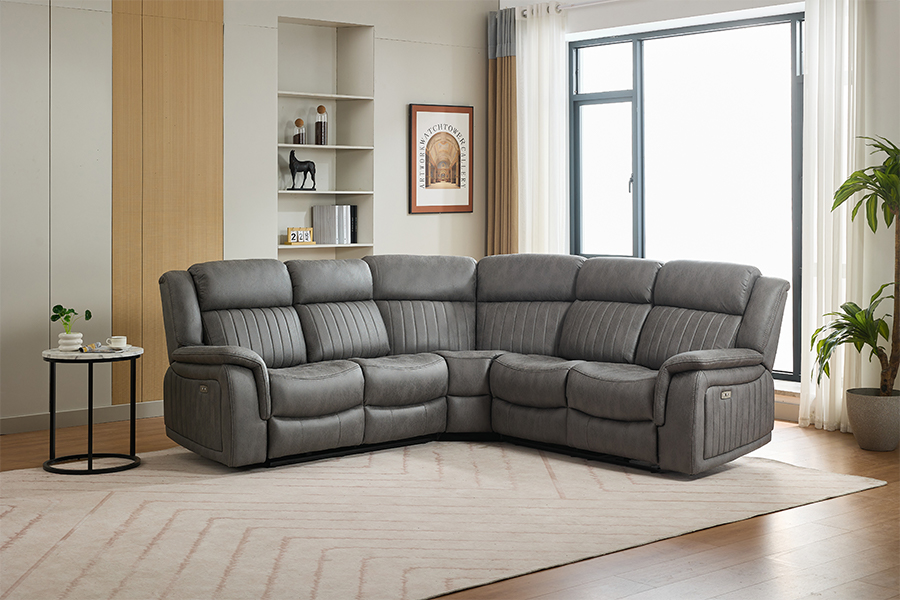 RC-7756 Power Reclining Sectional Sofa with Invisible Charger SocketThis power sectional offers pull-tab reclining, dual cup holders, and a built-in charger socket for everyday convenience. The technical fabric and corner-blocked frame support consistent use, and its modular design allows flexible configurations.View Product →
Five Mistakes That Undermine Modular Flexibility
- Buying the final layout on day one. A modular sofa is meant to grow with your situation. Start with a two- or three-seat base, live in the room for a few weeks, then add modules where they are actually needed.
- Mixing connectors across generations or suppliers. Spare brackets matter, because a missing connector can take an entire module out of rotation. Confirm that replacement parts will still be available.
- Choosing a fabric by appearance instead of abrasion rating. Look for a rub count above 40,000 for daily household use. Softer fabrics may look inviting but wear quickly on modules used every day.
- Forgetting cable access. In a flexible layout, recliners and charger ports need to stay near power. Reconfiguring a room becomes frustrating when every layout puts the power module too far from an outlet.
- Treating reconfiguration as a second purchase. The best modular systems let you adjust without buying new parts. If swapping layouts requires new brackets each time, the flexibility is only theoretical.
For importers and furniture brands planning a seating program, flexibility also depends on how easily the manufacturer can adapt module sizes, mechanisms, and fabrics. You can contact our team to review module dimensions and connector options before the sampling stage.
FAQ: Modular Sofas for Flexible Living Spaces
Q1: Can a modular sofa be fully disassembled when moving?
Yes. Each module separates from the others, so a large U-shaped system can be moved through standard doorways by carrying it in blocks. After the move, reassemble the units with the same connectors and tighten them as needed.
Q2: How many modules should I start with in a small apartment?
Begin with a two-seat armless sofa plus one ottoman. This supports a straight layout for everyday use and a temporary L-shape for movie nights. Add a corner module only after you have lived in the space for a few months.
Q3: Are modular sofas less sturdy than one-piece frames?
It depends on connector strength and frame quality. Well-built metal brackets and interlocking panels hold modules firmly. The weak points are usually found in low-cost systems that rely on plastic clips.
Q4: How do I stop modular sections from separating during use?
Locking mechanisms should click into place and hold without visible gaps. If sections slide, first confirm that the connectors on all modules are identical and that the floor is level. Anti-slip pads also help.
Q5: What fabric is easiest to maintain in a modular sofa?
For high-traffic homes, choose thick polyester or a polyester tech fabric with a tight weave. They resist stains and are simple to vacuum. Faux leather works for light use, while faux fur requires more careful maintenance.
A modular sofa for flexible living space is not a niche product. It is a practical response to rooms that refuse to stay the same. Choose a system with rigid connectors, replaceable cushions, and a fabric that matches your real level of daily use. When those three conditions are met, reconfiguring the room becomes a five-minute task instead of a furniture purchase.
Related Products

 Floor 2 No.533 Shuangqiao Road, Dipu Street, Anji County, Huzhou City, Zhejiang Province, China.
 Josie@boshenfurniture.com
 0086-15105823033
Copyright © BOSHEN FURNITURE CO., LTD. All rights reserved.OEM/ODM Upholstered Seating Furniture Manufacturers
